Few things transform a plain jacket, cap, or workwear uniform faster than a well-made patch, and custom iron on patches are the quickest route from idea to finished garment. No sewing machine, no tailor, and no waiting weeks for alterations. Just heat, pressure, and a design that is entirely your own.
Whether you are a school kitting out a leavers’ jacket, a rugby club branding training tops, a tradie protecting a company image on high-vis gear, or a streetwear label building a merch drop, iron on patches offer a fast, durable, and genuinely professional finish.
This guide walks through everything Patch Makers NZ customers ask before ordering: what iron on patches actually are, the different patch types available, and which fabrics accept heat-activated adhesive and which do not.
Moreover, find sizing and shape options, real-world use cases across New Zealand industries, and a full step-by-step application walkthrough. By the end, you will know exactly which patch style suits your project and how to order custom patches with confidence.
What Are Iron On Patches, Exactly?
An iron on patch is a fabric emblem, either embroidered, woven, printed, or moulded, with a layer of heat-activated adhesive fused to the reverse. When a household iron or commercial heat press applies sustained heat and pressure, the adhesive melts into the fibres of the garment underneath and bonds permanently once cooled.
Unlike a sticker or a temporary badge, a properly applied iron on patch becomes part of the fabric itself, capable of surviving repeated washing and everyday wear.
The adhesive backing is typically a hot melt film, sometimes described in the trade as heat transfer patches backing. It is applied during manufacturing, not something added afterwards, which is why choosing “iron on” as your backing option at the time of ordering matters.
Patch Makers NZ applies this backing consistently across embroidered, woven, PVC, and chenille patch bases, so the finishing method (embroidery, weave, or moulded rubber) and the attachment method (iron on, sew on, Velcro, or adhesive) can be mixed and matched to suit the project.
Types of Custom Iron On Patches
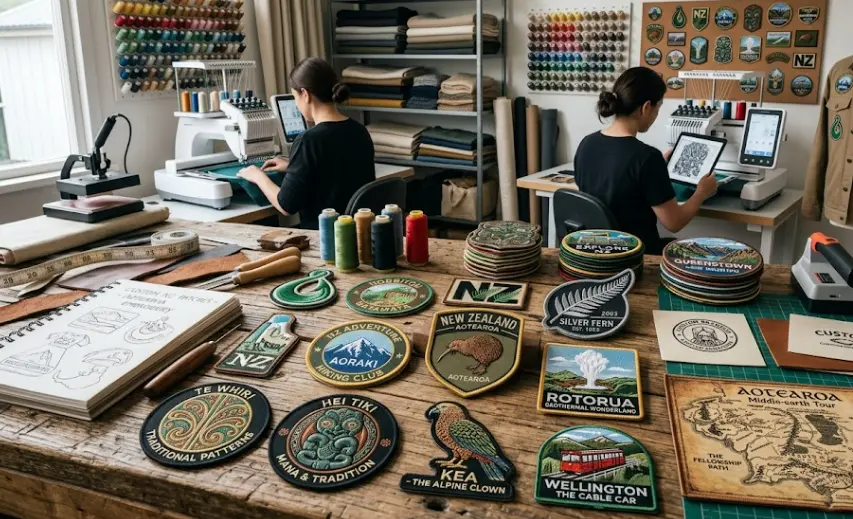
Not every patch is made the same way, and the manufacturing method has a direct effect on look, feel, durability, and price. Here are the main categories available for custom iron on patches NZ.
Embroidered Patches
The classic choice. Custom embroidered patches are stitched with coloured thread onto a twill backing, producing raised texture and a traditional, tactile finish. Embroidery is ideal for logos with bold lines, moderate detail, and one to eight thread colours.
It reads as premium and durable, which is why it remains the standard for sports clubs, military and emergency services groups, motorcycle clubs, and corporate uniforms. Fine text and gradient shading do not embroider well, so very detailed artwork usually points towards woven or printed alternatives.
Woven Patches
Custom woven patches use a tighter thread weave than embroidery, producing a flatter, smoother surface capable of capturing small text and intricate line work that embroidery would blur.
They suit designs with fine typography, thin outlines, or photographic-style detail, and they are a popular pick for brand labels, small logo patches on caps, and designs where a low-profile finish is preferred over raised stitching.
Chenille Patches
Custom chenille patches are built from looped yarn brushed into a soft, textured pile, giving that varsity jacket look associated with letterman jackets, school leavers’ patches, and collegiate branding.
They are thicker and bolder than embroidery, best suited to large lettering, numbers, and simple bold shapes rather than fine detail. Chenille is a strong choice for school and university leavers’ jackets across New Zealand, where a big, tactile letter patch is part of the tradition.
PVC Patches
Custom PVC patches are moulded from soft rubber like PVC in a silicone mould, producing a 3D, glossy finish with crisp colour separation. They are naturally waterproof, resistant to fading, and do not fray at the edges, making them a favourite for outdoor gear, tactical and adventure brands, and anyone wanting a modern, glossy alternative to traditional stitched patches.
PVC patches can be finished with an iron on backing, though because of their thickness a sew on or Velcro backing is often recommended for high-flex areas like bags.
Printed and Sublimated Patches
Digitally printed or dye-sublimated patches transfer a full-colour image directly onto polyester fabric, which means there is no limit on the number of colours or the level of photographic detail.
This method is the right call for gradients, photographs, complex multicolour artwork, and small production runs where embroidery setup costs would be uneconomical.
Leather and Faux Leather Patches
Debossed or laser-engraved genuine and vegan custom leather patches suit denim brands, caps, and premium product branding. They carry a rustic, high-end aesthetic that stitched or printed patches cannot replicate and are commonly finished with a sew on or rivet backing rather than iron on, given the thickness of the material.
Fabric Compatibility: What Iron On Patches Will and Will Not Stick To
Custom iron on patches rely on heat and fibre density to form a bond. Some fabrics welcome that bond readily. Others resist it, and a handful will be permanently damaged by the heat required.
Fabrics that iron on patches bond to well:
- Cotton: The gold standard. Dense natural fibres and high heat tolerance make cotton t-shirts, tote bags, and workwear ideal candidates.
- Denim: Thick and heat resistant, denim jackets and jeans are one of the most common surfaces for iron on denim patches, and the finish tends to last for years.
- Canvas: Heavy-duty and closely woven, canvas backpacks, aprons, and jackets hold an ironed patch extremely well.
- Cotton-polyester blends: Common in hoodies and school uniforms, blends generally accept iron on adhesive so long as the polyester ratio is not dominant.
- Wool and wool blend garments: Suitable at a lower heat setting, though a test patch on an inconspicuous area is worth doing first.
Fabrics that need caution or an alternative backing:
- Nylon and technical polyester: Common in raincoats, sports jerseys, and packable jackets, these synthetics can melt, pucker, or shine under direct iron heat. Sew on or Velcro backing is the safer route.
- Merino wool base layers: A genuine New Zealand wardrobe staple through winter, merino is fine and heat-sensitive. A pressing cloth, lower heat, and a test spot are essential, or a sew on patch is worth considering instead.
- Polar fleece: The high pile and synthetic fibre content mean fleece rarely holds an iron on patch reliably long term. Sew on or an adhesive dot combined with stitching tends to perform better.
- Leather and faux leather: Too heat-sensitive for a standard iron, though a heat press with controlled, low-dwell settings can work in professional hands.
- Waterproof or laminated shells: The waterproof membrane can be damaged by iron heat, breaking the garment’s water resistance. Velcro or sew on backing preserves the fabric’s function.
As a general rule, thicker, natural fibre, tightly woven fabrics are the best candidates, while thin, synthetic, or laminated fabrics call for a different backing option. Patch Makers NZ always recommends confirming garment fabric before finalising a backing choice, particularly for bulk custom patches orders where a failed application across dozens of units becomes an expensive mistake.
Sizing, Shape, and Backing Options
Custom patches are typically ordered in sizes ranging from a small 5 cm badge suited to a cap through to large 20 cm+ back patches for jackets and hoodies. Standard shapes include circles, ovals, shields, rectangles, and fully custom die-cut outlines that follow the exact silhouette of a logo.
Beyond the core iron on backing, most patch makers, including sibling backing categories offered across the wider patch network, provide hook-and-loop Velcro patches NZ, sew on, adhesive peel-and-stick, and combination backings (iron on plus sew on reinforcement) for applications that need extra hold.
For anyone unsure which shape or size suits their design, a simple rule applies: chest logos generally sit between 7cm and 10cm wide, cap patches between 5cm and 7cm, and back patches between 20cm and 30cm depending on jacket size.
Real-World Examples: Who Uses Custom Iron On Patches
Custom iron on patches for jackets and beyond show up across almost every industry in New Zealand:
Schools and Universities
Leavers’ jackets, house patches, and achievement badges, frequently in chenille for that bold varsity look.
Sports Clubs and Teams
Training kit branding, sponsor logos, and club crests applied across dozens of uniforms in a single bulk order.
Hospitality and Retail
Staff aprons, caps, and jackets branded with logo patches for a consistent, professional look without a costly embroidery machine on site.
Trades and construction
Hi-vis vests and workwear branded for both safety compliance and company recognition on site.
Motorcycle and Outdoor Clubs
Traditional embroidered back patches and PVC patches for jackets and gear, an area with strong heritage appeal.
Streetwear and Merch Brands
Small batch printed or woven patches applied to caps, tote bags, and jackets as part of a wider product drop.
Corporate Gifting and Events
Branded patches on caps or bags handed out at conferences, staff onboarding, or promotional events.
How to Apply an Iron On Patch: Step by Step
- Preheat the iron to a medium-high, no-steam setting appropriate for the garment fabric (cotton and denim tolerate higher heat than blends or wool).
- Position the patch on clean, dry fabric exactly where it will sit permanently. There is no repositioning once heat is applied.
- Cover with a pressing cloth or thin fabric to protect both the patch and the iron plate.
- Press firmly for 20 to 30 seconds, applying even, steady pressure rather than sliding the iron across the surface.
- Flip the garment inside out, if practical, and press the reverse of the patch area for a further 15 to 20 seconds to lock the bond from both sides.
- Let it cool undisturbed for several minutes before handling or wearing the garment.
- Reinforce with a few stitches around the patch edges for garments that will see heavy wear or frequent washing, extending the life of the bond well beyond adhesive alone.
Caring for Iron On Patches
A correctly applied patch will comfortably survive regular machine washing on a cool or warm cycle. Turning the garment inside out before washing, avoiding the tumble dryer’s highest heat setting, and skipping fabric softener directly over the patch all help preserve the adhesive bond and the crispness of embroidery or print over time.
Why Order Custom Iron On Patches from Patch Makers NZ
Patch Makers NZ produces custom embroidered patches, custom woven patches, custom chenille patches, custom PVC patches, and custom printed patches with iron on, sew on, Velcro, or adhesive patch backings, all manufactured to New Zealand order volumes without inflated minimum order requirements.
Where many overseas patch suppliers add weeks of international shipping, Patch Makers NZ works to timelines that suit local schools, clubs, and businesses, with digital proofing before production so the design is confirmed before a single stitch is sewn.
Bulk pricing tiers, straightforward reordering for repeat uniform runs, and NZ-based support make it a more practical choice than sourcing patches through an offshore marketplace listing with unclear turnaround and no direct contact for adjustments.
Frequently Asked Questions
How long do iron on patches last?
A correctly applied iron on patch on a suitable fabric such as cotton or denim typically lasts several years through regular washing. Reinforcing the edges with a few hand stitches extends durability further, particularly on garments worn daily.
Can iron on patches be removed?
Yes, applying heat again while gently lifting an edge with a blunt tool usually releases the adhesive. Any residue left behind can be lifted with a fabric-safe adhesive remover, though the garment fibres underneath may show a faint outline.
Do iron on patches work on polyester jackets?
It depends on the polyester weight and finish. Heavier polyester workwear generally accepts iron on adhesive, while thin, technical, or laminated polyester shells risk melting or losing water resistance, so a sew on or Velcro backing is the safer option.
What is the difference between embroidered and woven patches?
Embroidered patches have raised, textured stitching suited to bold logos, while woven patches lie flatter and capture finer text and detail. The choice comes down to how much fine detail the artwork contains.
Is there a minimum order for custom patches in New Zealand?
Patch Makers NZ accepts both small personal orders and large bulk runs for schools, clubs, and businesses without imposing an unreasonably high minimum, making custom patches accessible for one-off projects as well as ongoing uniform programmes.
Can I combine iron on with sew on backing?
Yes, this is a common and recommended combination for patches on heavily used garments. The iron on adhesive holds the patch in place instantly, and a light row of stitching around the border locks it in permanently.
How much do custom iron on patches cost?
Pricing depends on patch size, colour count, quantity, and manufacturing method, with PVC and embroidered patches generally costing more per unit than simpler printed designs. Bulk orders reduce the per patch price significantly, and a formal quote is the most accurate way to budget a project.
Bring Your Design to Life with Patch Makers NZ
From a single leavers’ jacket patch to a bulk order of branded workwear across an entire team, custom iron on patches remain one of the fastest and most reliable ways to add a permanent, professional design to fabric without a needle and thread.
Choosing the right patch type, whether embroidered, woven, chenille, PVC, or printed, and matching it to a fabric that can genuinely hold the bond, is the difference between a patch that lasts for years and one that peels within a season.
Patch Makers NZ brings all of these options together under one local, no-fuss ordering process, with the fabric guidance and backing recommendations covered in this guide built directly into every quote. Ready to Order? Get your free custom iron on patch quote by contacting us today.