
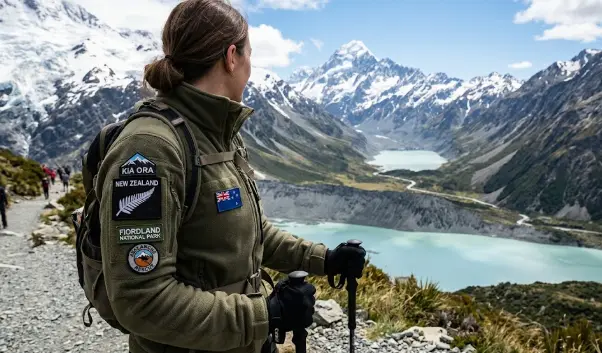
Velcro patches, often referred to as hook-and-loop patches, are types of patches, such as embroidered, PVC, or woven, that feature a hook-and-loop closure system affixed to their back. The “hook” part (stiff, rough texture) connects securely to a “loop” panel (soft, textile surface) that has been sewn or ironed onto your clothing, bag, or other equipment.
This mechanism allows you to switch out, reposition, or remove the patch quickly and easily without needing any tools or causing damage to the material. They are the preferred fastening for military uniforms, specialized tactical gear, sports uniforms, occupational clothing, motorcycle jackets, and any scenario requiring a patch that can be detached and reused.
What Are Velcro Patches?
Velcro patches are customizable badges made from materials like embroidery, PVC, woven fabric, or leather. They feature a hook-and-loop fastening mechanism on their reverse side, either replacing or supplementing traditional sew-on or iron-on adhesive.
The term “Velcro” is technically a legally protected brand name (Velcro® Companies), yet it has become the common, everyday phrase used to describe any hook-and-loop fastener globally. This usage is similar to how “Sellotape” in New Zealand is used for any transparent adhesive tape, regardless of the manufacturer.
The defining feature of a Velcro patch is its removability without damage. In contrast to a sew-on badge that is permanently stitched to fabric, or an iron-on badge that creates a permanent bond using heat and adhesive, a Velcro patch can be peeled away neatly and reapplied instantly.
This unique attribute has established Velcro patches as the dominant fastening method for military, tactical, outdoor, sports, and professional uniforms both throughout New Zealand and internationally.
In New Zealand, Velcro patches are utilized by:
- NZDF personnel for swapping rank and unit badges between various uniforms
- Sports clubs in locations like Auckland, Wellington, and Christchurch for attaching team emblems to practice gear
- Outdoor adventure companies for branding staff outerwear and backpack covers
- Motorcycle clubs from Northland to Southland for displaying chapter identifiers on their riding apparel
- Emergency services and security firms for rapid identification of personnel in operational settings
- Schools and youth groups such as Scouts and cadets for fastening badges to their uniforms
- Businesses and brands for developing promotional items and corporate workwear
If you require a patch that remains fixed when you need it but can be taken off easily when you do not, Velcro patches offer the perfect solution.
How Do Velcro Patches Work? (Hook & Loop Explained)
A clear understanding of the mechanics behind Velcro patches is helpful for selecting the appropriate type and ensuring its longevity.
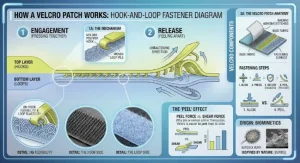
A hook-and-loop fastener comprises two distinct fabric surfaces specifically designed to latch onto one another:
The Hook Side (rough / scratchy) This is known as the “male” component. Its surface is covered with thousands of minute, stiff, curved plastic hooks. It is usually constructed from nylon or polyester. For patches, the hook side is either secured with glue or stitching to the patch’s reverse. Running your finger across it produces a rough, abrasive sensation.
The Loop Side (soft / fuzzy) This is the “female” component. It is woven with thousands of pliable, soft fiber loops, typically made of nylon. The loop side is affixed to your clothing, jacket, bag, headwear, or any area where you intend to secure your patch. It feels soft and cloth-like to the touch.
The Engagement When the hook side of the patch is pressed firmly against the loop side on your apparel, the hooks engage and lock into the loops. The stronger the pressure applied and the greater the area covered, the more secure the hold. A standard 80mm × 50mm patch area generates sufficient grip to withstand several kilograms of pulling force, making it highly secure for any wearable use.
The Release Pulling the patch off at an angle, rather than pulling straight away from the surface, significantly reduces the effort needed to detach the hooks from the loops. This is the reason Velcro patches are easy to remove intentionally, yet they remain firmly attached during routine movement and activities.
| A note on grip strength: High-quality hook-and-loop fasteners utilized for professional and military patches (like specialized Velcro® products) undergo testing for significantly superior peel and engagement strength compared to typical consumer hook-and-loop tape. When Patch Makers NZ manufactures custom Velcro patches, we use professional-grade nylon hook-and-loop material designed to hold up effectively under challenging field conditions. |
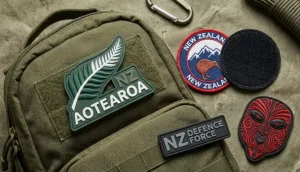
Types of Velcro Patches Available in NZ
The description “Velcro patch” refers to the attachment method, not the material or production technique of the patch itself. Any style of patch can be made with Velcro backing. Below are the primary types available from Patch Makers NZ:
1. Embroidered Velcro Patches
This is the most common and classic style. Threads are stitched over a foundational woven fabric to produce a textured, raised design. Embroidered Velcro patches offer a classic, high-quality appearance that is ideal for uniforms, club badges, and team emblems.
- Best for: Uniform badges, club logos, military insignia, team crests, school badges
- Feel: Textured, with raised stitching on a fabric base
- Coverage: Typically 50%–80% thread coverage. Higher coverage results in a more prominent look
- Durability: Excellent for daily wear. Threads may fray if caught on rough objects
- Available at: Custom Embroidered Patches NZ
2. PVC Velcro Patches
PVC (polyvinyl chloride) patches are created by molding them from a colorful, rubber-like plastic. They are fully water-resistant, extremely durable, and simple to wipe clean. This makes them the leading choice for outdoor, tactical, and workwear applications. PVC Velcro patches maintain their shape and color even in severe environments.
- Best for: Tactical equipment, outdoor gear, military morale badges, wet conditions, harsh usage
- Feel: Rubber-like, slightly pliable, with a smooth or textured finish
- Coverage: Complete coverage. Capable of achieving photographic detail and utilizing vibrant flat colors
- Durability: Exceptional waterproof, UV-resistant, and abrasion-resistant quality
- Available at: Custom PVC Patches NZ
3. Woven Velcro Patches
Woven patches are crafted on specialized machines that weave the design directly into the patch fabric, rather than stitching threads on top. This results in a thin, flat patch with very fine detail, making it superior to embroidery for small text and complicated line designs.
- Best for: Name tags, fine lettering, detailed logos, professional uniform badges
- Feel: Flat and smooth, without any raised threads
- Coverage: Full-surface coverage. Small text and thin lines are distinctly legible
- Durability: Outstanding. Their flat design prevents raised threads from catching or unraveling
- Available at: Custom Woven Patches NZ
4. Leather Velcro Patches
Patches made from genuine or synthetic leather with Velcro backing provide a high-end, rugged look. They age beautifully and are well-suited for motorcycle clubs, fashion labels, and premium work apparel.
- Best for: Motorcycle jackets, biker groups, fashion brands, high-quality uniforms
- Feel: Authentic leather texture. Can feature debossing, laser-engraving, or printing
- Durability: Very good. Leather develops a natural patina with use
- Available at: Custom Leather Patches NZ
5. Chenille Velcro Patches
Chenille patches utilize thick yarn cut into loops to form a velvety, soft, and raised surface. Traditionally seen on varsity and letterman jackets, chenille Velcro patches are frequently chosen by sports teams and schools.
- Best for: Varsity jackets, sports honors, school letters, team badges
- Feel: Soft, thick, fluffy. The classic texture of a “varsity patch”
- Durability: Suitable for display purposes. Not recommended for heavy-duty outdoor or tactical wear
- Available at: Custom Chenille Patches NZ
6. Sublimated Velcro Patches
Sublimated patches use heat and specialized dyes to transfer a full-color digital image directly into the fabric. This process enables photorealistic images, gradients, and elaborate color work that cannot be replicated through embroidery.
- Best for: Full-color designs, photographic-quality logos, gradient artwork, promotional badges
- Feel: Fabric surface, smooth and flat
- Durability: Good. Colors are permanently set within the fabric fibers, not merely printed on the surface
- Available at: Custom Sublimated Patches NZ
Quick Comparison Table: Velcro Patch Types
| Patch Type | Best Use Case | Water Resistance | Detail Level |
| Embroidered | Uniforms, club, military | Moderate | Medium |
| PVC | Tactical, outdoor, workwear | Excellent (waterproof) | High |
| Woven | Name tapes, fine logos | Moderate | Very High |
| Leather | Motorcycle, fashion | Good | Medium |
| Chenille | Sports, schools, varsity | Low | Low-Medium |
| Sublimated | Photo-realistic, full-colour | Moderate | Very High |
Prices are base rates per patch for minimum order quantities: See full pricing.
Velcro Patch Backing Options: What is the Difference?
When ordering customized patches in New Zealand, the “backing” refers to the method used on the patch’s reverse to attach it to your clothing or equipment. Many new customers mistakenly confuse the patch type (e.g., PVC, embroidered) with the backing method. They are, in fact, two distinct choices.
Here is a comprehensive list of backing options available at Patch Makers NZ:
| Backing Type | How It Works | Removable? | Best For |
| Velcro / Hook & Loop | Hook side on patch; loop panel on garment | Yes, easily | Uniforms, tactical, sports, outdoor |
| Iron-On / Heat Seal | Heat-activated glue bonds patch to fabric permanently | No (without effort) | Casual clothing, denim, backpacks |
| Sew-On | Patch stitched directly onto garment | No | Permanent applications, heavy use |
| Peel & Stick / Self-Adhesive | Pressure-sensitive adhesive on patch back | Yes (limited reuse) | Temporary display, smooth surfaces |
| Magnetic Backing | Magnets hold patch to fabric | Yes | Thin fabrics, no-damage applications |
| Pin Backing | Metal pin through patch and fabric | Yes | Lapels, hats, bags |
| Button Loop | Loop allows patch to button onto garment | Yes | Military-style garments |
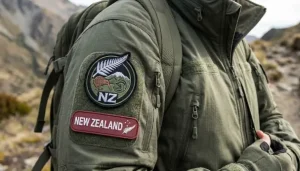
Velcro vs Iron-On vs Sew-On Patches: Which Is Best for You?
This question is frequently asked by new patch purchasers. The correct choice depends entirely on the intended application.
When Velcro Patches Are the Right Choice
Select Velcro backing when:
- You need to switch a patch between multiple garments (e.g., using the same name tape on a uniform jacket, a tactical vest, and a training shirt)
- Your garment is already fitted with pre-attached loop panels. Many military uniforms, tactical vests, outdoor brand jackets, and certain types of sports gear come with built-in loop fields
- Your work setting requires rapid changes to patches, such as rank updates, role changes, or event-specific identification
- The patch will be exposed to outdoor elements: Velcro backing is more resistant to water compared to iron-on adhesive, which can fail after repeated cycles of getting wet and drying
- You wish to prevent permanent changes to your garment. Velcro patches leave no residue or damage upon removal
When Iron-On Patches Are the Right Choice
Select iron-on patches backing when:
- The patch is intended to remain permanently on a single item of clothing (like denim jackets, jeans, or school backpacks)
- You desire the fastest application method that requires no sewing skills
- The garment material is cotton, poly-cotton, or denim. These fabrics are the most reliable surfaces for iron-on adhesive bonding
- Price is the main consideration and iron-on backing represents the least expensive attachment option
When Sew-On Patches Are the Right Choice
Select sew-on backing when:
- You require the most durable and permanent bond. Stitching provides a structural connection that neither iron-on glue nor Velcro can match for high-stress placements
- The patch is being attached to leather, nylon, thick canvas, or waterproof materials that iron-on adhesive cannot properly bond to
- The garment will be laundered frequently and at high temperatures
- You are attaching large back patches to motorcycle cut-off vests or jackets where heavy movement and gravity place significant stress on the patch edges
Head-to-Head Comparison
| Factor | Velcro | Iron-On | Sew-On |
| Removability | Easy, damage-free | Difficult | Permanent |
| Reusability | Thousands of cycles | One-time only | One-time only |
| Strength on garment | Very good | Good (on correct fabric) | Excellent |
| Water resistance | Good | Moderate (adhesive can fail) | Excellent |
| Application ease | No tools needed | Iron required | Sewing required |
| Works on all fabrics | Yes (with loop panel) | Not all fabrics | Yes |
| Best for multiple garments | Yes | No | No |
| Military/tactical suitability | Industry standard | Not standard | Yes |
Bottom line for New Zealand buyers: If your patches must be transferable between different pieces of clothing or gear, or if you operate in a professional, military, or outdoor environment, Velcro backing is the optimal choice. For permanent, casual fashion use on a single garment, iron-on or sew-on methods are simpler alternatives.
Who Uses Velcro Patches in New Zealand? (Use Cases)
New Zealand features a uniquely varied patch culture, influenced by its military heritage, outdoor recreational sector, sporting activities, and strong community identity. Here is how different groups across Aotearoa utilize Velcro patches:
Military and Defence
The New Zealand Defence Force (NZDF), encompassing the Army, Navy, and Air Force, uses hook-and-loop backed patches for identifying rank, unit affiliation, names, and operational roles on their DPCU and MCCUU uniform systems. Velcro is the required NZDF standard because personnel move between assignments, and changes in rank necessitate only a quick patch exchange instead of the complex re-stitching of insignia. Our custom military patches are manufactured to meet the specific requirements for both standard and personalized unit badges.
Police and Emergency Services
Teams from NZ Police, Fire and Emergency NZ (FENZ), and St John Ambulance use Velcro name patches, rank patches, and identification badges on vests, jackets, and plate carriers. The practicality of moving a name tag between a patrol vest and a high-visibility jacket without needing to sew is essential for operational staff. See our custom police patches for more details.
Security Industry
Private security companies across New Zealand rely on Velcro-backed patches for company logos, names, and role identification on uniforms. Velcro simplifies the process of managing standardized patches that can be swapped among company-issued uniform items when employees change shifts or roles.
Sports Teams
From club rugby teams in Hawke’s Bay to netball clubs in Dunedin, sports organizations use Velcro patches for displaying team crests, player names, and sponsor logos on training jackets, kit bags, and warm-up gear. A Velcro sports emblem on a training jacket can be transferred to a fan’s jacket or easily updated with a new design at the start of a new season. Explore our custom sports patches range.
Tactical and Airsoft / Milsim Communities
New Zealand’s active airsoft (military simulation) and tactical communities are among the heaviest users of Velcro tactical and morale patches. Tactical vests, plate carrier replicas, and specialized backpacks generally come with large loop-panel areas. The morale patch subculture is driven by Velcro compatibility, allowing enthusiasts to easily trade fun, humorous, or team-specific patches with other players. Browse our custom morale patches range.
Outdoor and Adventure Industry
Guiding businesses, conservation groups, outdoor education providers, and adventure tourism companies throughout New Zealand use Velcro patches for branding staff gear and uniforms. Personnel who work across different field locations often carry a single set of patches that they move between their fleece, rain jacket, softshell, and pack cover, all stored in one kit bag.
Motorcycle Clubs
Motorcycle clubs in both the North and South Islands use Velcro-backed patches on their riding vests and jackets, sometimes alongside or in place of sewn patches. Velcro patches provide club members with the flexibility to showcase chapter, event, and commemorative patches that change throughout the riding year. Our custom motorcycle patches include Velcro backing options.
Schools, Cadets, and Youth Organisations
Youth organizations like Scouts and guides, school kapa haka groups, and cadet units throughout New Zealand use Velcro patches for group insignia, role identification, and achievement badges on backpacks, jerseys, and uniform shirts.
Workwear and Corporate Branding
Businesses in healthcare, utilities, construction, and hospitality use Velcro logo patches and name tags on staff uniforms. Velcro dramatically simplifies name patch administration, particularly in environments with high staff turnover. Replacing a name patch is significantly cheaper than replacing an entire custom-embroidered uniform.
Best Velcro Patches for Specific Applications
Different usage scenarios require different patch materials. Here is the recommended Velcro patch option for various needs:
Best for Military and Tactical: PVC + Hook & Loop
PVC Velcro patches are considered the top standard for tactical, military, and law enforcement use in NZ. The reasons include:
- Waterproof: They do not absorb moisture during operations in wet conditions
- Cleanable: Dirt, mud, and debris can be easily removed with a damp cloth
- Night-vision friendly versions available: Subdued color options that do not reflect infrared light
- Dimensionally stable: They resist stretching, shrinking, or fraying, unlike embroidered patches under extreme use
For standard military uniform insignia where the goal is to match existing service dress patches, embroidered Velcro patches on a twill base remain the traditional selection.
Best for Sports Teams: Embroidered + Hook & Loop
Embroidered Velcro patches achieve the ideal balance of classic appearance, value, and resilience for sports clubs. They hold up well to washing machine cycles, maintain their color across seasons, and provide the high-quality, “authentic badge” feel expected of a team crest, distinguishing it from a printed iron-on design.
Best for Outdoor and Adventure: PVC or Woven + Hook & Loop
For adventure tourism operators and outdoor guides, the choice depends on their desired branding aesthetic. PVC Velcro patches are best for high-activity, wet roles where the patch faces constant rain, movement, and mud. Woven Velcro patches offer a more refined, professional appearance for customer-facing staff kits and softshell uniforms.
Best for Motorcycle Clubs: Embroidered or Leather + Hook & Loop
Motorcycle clubs often combine traditional sewn-on back patches with Velcro-backed smaller patches for the chest and sleeves that are changed more frequently. Embroidered Velcro patches keep the traditional look while offering the flexibility to swap rally, event, and run patches during the riding season.
Best for Workwear / Name Patches: Woven + Hook & Loop
Woven Velcro name patches are the professional benchmark for workwear. Their flat profile looks neat on formal uniforms and collared shirts. Fine text, including job titles, full names, and company details, is crisp and readable at the small scale of a woven patch. Our custom name patches and custom uniform patches pages cover this topic in depth.
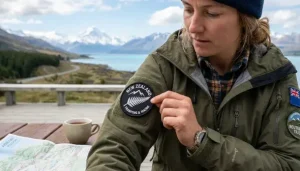
How to Attach a Velcro Patch (Jacket, Hat, Bag & More)
Here is a quick overview.
Attaching to a Jacket with an Existing Loop Panel
If your jacket already includes a loop panel (common on many tactical jackets, military wear, and outdoor gear from various brands), simply place the patch hook-side down onto the loop panel. Carefully align the edges. Overhanging edges can become stress points. Apply firm, steady downward pressure for 10–15 seconds over the entire patch surface.
Attaching to a Jacket Without a Loop Panel
You will need to install a loop panel first. Your options include:
- Iron-on loop tape (loop panel with pressure-sensitive adhesive): Cut a loop panel slightly larger than your patch. Iron it onto the jacket at 160°C for 20–30 seconds if the material is poly-cotton or cotton. Press the hook side of the patch onto the newly bonded loop panel.
- Sew-on loop tape: Stitch a loop panel onto the jacket exactly where you want the patch to sit. This method is more robust than iron-on for jackets that are washed regularly.
Attaching to a Hat
Most military-style and tactical caps feature a loop panel on the front specifically for Velcro patches. Position your patch and press it down firmly. If your hat lacks a loop panel, sewing one onto the front or crown is the most secure solution. Iron-on loop tape may work on structured hats but might not adhere properly to curved surfaces.
Attaching to a Bag or Backpack
Many outdoor and tactical packs are designed with loop-faced panels or MOLLE webbing areas intended for patches. If your bag does not have a loop surface, self-adhesive loop patches can be applied to clean, smooth nylon or canvas for good short-term attachment, though sewing is recommended for a permanent fixture.
What Is a Loop Field / Loop Panel?
The terms “loop field,” “loop panel,” “Velcro field,“ and “hook-and-loop backing area” are often used interchangeably within the patch, military, and tactical communities.
A loop field is simply a dedicated area of soft, looped hook-and-loop material. This is the “female” component that is permanently fixed to a vest, garment, helmet, pack, or other equipment. It is the designated surface onto which your Velcro patches adhere.
Standard loop field sizes in the NZ context:
| Application | Typical Loop Field Size |
| Cap / hat front panel | 50mm × 80mm (standard morale patch size) |
| Chest patch panel on jacket | 80mm × 50mm or 100mm × 60mm |
| Sleeve ID panel | 50mm × 80mm or custom |
| Tactical vest front panel | 100mm × 80mm or larger |
| Name tape panel | 25mm × 100mm (standard name tape) |
| Large back panel | 200mm × 150mm and up |
When placing an order for custom Velcro patches, ensure the patch dimensions are no bigger than the loop field on your garment. A patch that extends beyond the loop field will have unsupported edges that can snag and peel away.
At Patch Makers NZ, we can manufacture loop panels in any custom size and shape to perfectly match your specific uniform. If you are developing a new uniform program and require both the loop bases and the patches, contact us for guidance on the best combination.
Custom Velcro Patches NZ: How to Order?
Placing an order for custom Velcro patches from Patch Makers NZ is a simple, standardized procedure. Here is a breakdown of the steps involved:
Step 1: Choose Your Patch Type
Decide on the material for your patch: embroidered, PVC, woven, leather, chenille, sublimated, or another style we offer. If you are uncertain which material suits your design best, our team can provide recommendations after reviewing your artwork.
Step 2: Submit Your Design
Upload your logo, sketch, concept, or design files using our online quote form. Your design does not need to be refined or ready for production. We employ in-house designers who can transform your rough idea into a production-ready file. Free design service is included with every order.
Step 3: Confirm Your Specifications
During the quoting process, you will finalize:
- Patch dimensions (height × width in inches or mm)
- Patch type (e.g., embroidered, PVC)
- Backing: Hook & Loop (Velcro) with both the hook and loop included, or hook-side only if you are applying the patch to an existing loop panel
- Quantity (minimum order of 10 pieces)
- Any special requests (e.g., specific pantone colors, subdued colors, night-vision-compatible materials)
Step 4: Approve the Free Digital Mockup
Before we proceed to production, we will create a complimentary digital mockup of your patch, showing the exact layout, dimensions, and colors. You must review it and request any necessary adjustments. We will revise it until you are completely satisfied. No charge for revisions.
Step 5: Production and Delivery
Once you have approved the mockup, production begins. The standard processing time for New Zealand orders is 7–10 business days. Expedited production options are available if you require your patches sooner. We ship to all locations across New Zealand, including Auckland, Wellington, Christchurch, Hamilton, Tauranga, Dunedin, and regional areas.
Ready to start? Get a free quote.
Velcro Patch Sizing Guide
Accurate sizing is essential for Velcro patches. The patch must fit precisely inside the loop panel on your apparel without any overhang.
Standard Velcro Patch Sizes
| Size | Dimensions | Common Application |
| Small | 50mm × 50mm | Hat badges, small sleeve patches |
| Standard morale patch | 80mm × 50mm | Cap front panels, chest patches |
| Name tape | 100mm × 25mm | Uniform name patches |
| Medium | 100mm × 80mm | Chest patches, bag patches |
| Large | 150mm × 100mm | Jacket chest panels, back patches |
| Extra large | 200mm × 150mm and above | Full back patches, large vest panels |
Sizing Tips for New Zealand Buyers
- Military uniform patches: NZDF patch areas adhere to NATO-compatible measurements. The standard chest panel size is 80mm × 50mm. Name tapes are typically 100mm × 25mm.
- Tactical vests: Loop field sizes vary significantly based on the vest manufacturer. It is best to measure your loop field and provide those dimensions when ordering.
- Caps and hats: Most tactical caps use an 80mm × 50mm front panel.
- Custom garments: If you are ordering apparel with custom loop panels, we suggest allowing a 5mm edge clearance beyond the loop field on all sides to eliminate the risk of the patch extending past the attachment area.
For designs with irregular shapes (like roundels, shield shapes, or flags), we create custom-shaped patches and can advise on the appropriate loop panel shape to match.
Velcro Patches Pricing in NZ
The cost of a Velcro patch depends on its type, size, complexity of the design, and the quantity ordered. Adding hook-and-loop backing incurs a minor extra charge compared to standard sew-on backing, but this difference is minimal considering the added functionality.
How to Care for and Maintain Velcro Patches
Proper maintenance ensures your Velcro patches retain their full gripping power for many years.
A quick maintenance summary for NZ conditions:
Cleaning the hook side (patch): Remove foreign objects like grass seeds, Tongariro mud, or gorse prickles by using a dedicated Velcro cleaning brush or a fine-toothed comb. Drag the comb along the hook rows to lift out any trapped debris. Perform this cleaning after every outdoor use before storing the patch.
Cleaning the loop side (garment panel): Use a soft-bristle brush and gently apply light circular motions to restore the loop pile to its upright height. Flattened loops result in reduced grip. A quick brush typically restores functionality.
Washing: Velcro patches are usually safe for machine washing at 30°C–40°C. Always close the hook panels before washing, as open hooks will trap lint and debris from other items in the laundry. For PVC patches, cold machine wash or hand washing is preferred to prevent the plastic surface from cracking due to high heat.
Storage: Store patches with the hook side fully engaged (either pressed onto a loop surface or onto itself) to prevent the hooks from bending out of shape or snagging other items.
When grip fails: The most frequent cause of lost holding power (in 80% of cases) is contamination from debris. Thoroughly clean both the hook and loop surfaces before assuming the Velcro needs to be replaced. If cleaning doesn’t restore the grip, the loop panel on the garment may need replacement, as this is a standard maintenance task after 2–3 years of extensive use.
For more details on how to care for your custom patches, read our expert guide.
Frequently Asked Questions
What are Velcro patches?
Velcro patches are custom-made patches, available in materials like embroidered, PVC, or woven, that have a hook-and-loop fastening system on their reverse side. The “hook” section on the patch connects firmly with a “loop” panel on your apparel, enabling the patch to be removed and reattached repeatedly without causing any damage to the fabric. They are also universally known as hook-and-loop patches or Velcro® patches.
Are Velcro patches the same as hook-and-loop patches?
Yes, they are exactly the same. “Velcro” is a corporate brand name (Velcro® Companies) that has become the generalized term for any hook-and-loop fastener, similar to how “Sellotape” is used broadly for clear adhesive tape in NZ. When patch suppliers, including Patch Makers NZ, refer to “Velcro backing” or “hook-and-loop backing,” the meaning is identical.
How strong is Velcro patch backing?
Commercial-grade nylon hook-and-loop backing, when of high quality, generates 4–8 kg of pull resistance for every 100 cm² of connected surface for a standard patch. A typical 80mm × 50mm patch holds enough grip to withstand several kilograms of direct pull force. For practical wear, this capacity is more than adequate to keep a patch securely in place during vigorous activity, running, or heavy labor. Mil-Spec Velcro, used for military uniforms, adheres to even stricter engagement strength requirements.
Can Velcro patches be washed?
Yes, you can machine wash Velcro patches. For embroidered Velcro patches, it is recommended to use a gentle cycle with cold water or a maximum of 30°C. For PVC Velcro patches, a gentle machine wash or handwashing in cold water is preferred. Crucially, always secure the hook-side panels before washing, as open hooks will trap lint and debris from other laundry items.
How long do Velcro patches last?
High-quality nylon hook-and-loop backing can withstand approximately 10,000 to 20,000 cycles of attachment and detachment before its grip noticeably diminishes. In practical, everyday use, a properly maintained Velcro base on outdoor gear or a uniform generally lasts between 3 to 5 years. The patch material itself (e.g., PVC, embroidered, woven) usually lasts longer than the Velcro attachment system.
What is the difference between the hook side and the loop side?
The hook side is the rough, abrasive component covered with small plastic hooks. This part is secured to the back of your patch. The loop side is the soft, fuzzy component made of woven fiber loops. This part is permanently attached to your gear, bag, or garment. When the hook side of the patch is pressed into the loop side on the garment, they lock together, holding the patch in place.
Do Velcro patches come with both hook and loop sides?
When ordering custom Velcro patches from Patch Makers NZ, you have two options: Hook side only (for the patch back) if your garments already have loop panels sewn on, or Full set (hook side on the patch plus corresponding loop panels for your garments). Most first-time buyers who do not have existing loop panels will select the full set.
Can I put Velcro patches on any jacket?
You are able to attach Velcro patches to almost any jacket, provided the jacket is first fitted with a loop panel in the desired location. You can add a loop panel yourself by using iron-on loop tape (apply at 160°C for 20–30 seconds on poly-cotton/cotton) or by sewing a loop panel onto the jacket. For waterproof, nylon, and leather jackets, sewing is the suggested method, as iron-on adhesive may not bond securely to these materials.
Are Velcro patches suitable for hats?
Yes. Numerous tactical, military, and outdoor-style caps come standard with a dedicated loop panel on the front crown specifically for attaching Velcro patches. Standard cap-front and morale Velcro patches typically measure around 80mm × 50mm. If your hat lacks a loop panel, you can have a small one sewn onto the crown.
What is a morale patch, and do they use Velcro?
A morale patch is a small, custom badge, often humorous, identity-based, or motivational, worn on military uniforms, tactical gear, or casual clothes. Velcro backing is fundamental to the morale patch trend, as it enables wearers to easily swap patches between different pieces of gear and collect patches from others. The entire morale patch community relies on Velcro compatibility. View our custom morale patches →
What is a Velcro name patch?
A Velcro name patch, also known as a name tape, is a flat strip (either woven or embroidered) displaying an individual’s name, and often their role or rank, which is affixed to a uniform using hook-and-loop backing. In New Zealand, Velcro name patches are standard on security uniforms, police vests, NZDF uniforms, and many corporate workwear programs. The Velcro backing allows a name patch to be instantly replaced if a staff member changes their name or role or is transferred between different garments. See our custom name patches.
How do I remove a Velcro patch without damaging the fabric?
To detach a Velcro patch cleanly, grip one corner and peel the patch away at a low angle (avoid pulling straight up). Peeling at an angle progressively separates the rows of hooks, which requires significantly less force than pulling directly away. This technique safeguards both the loop panel and the patch from damage. Because no adhesive is used, the garment fabric is completely unaffected.
Can I wash clothes with Velcro patches on them?
Yes, but you must secure the hook panels before washing. If left open in a washing machine, the hook-side Velcro acts like a mechanical abrasive, grabbing onto and causing pilling and damage to towels, clothing, and other items in the load. Always close all hook panels (by pressing them against a loop panel or folding them onto themselves) before placing any Velcro-equipped garments into the laundry.
What fabrics do Velcro patches NOT work on?
Velcro patches require a loop panel surface to fasten to. They will not stick to smooth, bare fabrics, waterproof membranes, nylon, or leather without a dedicated loop panel. However, you can add a loop panel to almost any surface using sew-on loop tape. For hard, smooth surfaces (like hard shell armor or helmets), industrial-strength adhesive backing is used to attach Velcro loop panels.
Where can I buy Velcro patches in New Zealand?
Patch Makers NZ manufactures custom Velcro patches and ships them nationwide across all of New Zealand, including Dunedin, Christchurch, Wellington, Auckland, Hamilton, Tauranga, and all regional areas. With a low minimum order of just 10 patches, a complimentary digital mockup, and free design service included, we serve large organizations, businesses, sports clubs, and individual customers. Get a free quote here.
Can I order Velcro patches in small quantities in NZ?
Yes. Patch Makers NZ maintains a minimum order quantity of only 10 patches, which is one of the lowest available in New Zealand. This accessibility allows individuals, small community groups, startup brands, and small sports clubs to order custom professional patches without needing a large bulk commitment. The price per patch decreases as the ordered quantity increases.
Are PVC or embroidered Velcro patches better for outdoor/tactical use?
PVC Velcro patches are superior for tactical and outdoor use. They are fully waterproof, simple to clean, resistant to UV damage, and can be made in infrared-invisible or subdued color schemes for military use. Embroidered Velcro patches are a better choice when a traditional, textile-based badge look is preferred, such as for ceremonial wear, formal uniforms, and club insignia.
Order Velcro Patches from Patch Makers NZ Today
Velcro patches are our area of specialization. Manufacturing them correctly demands the right type of hook-and-loop materials, the correct method of application to the patch backing, and the precise expertise to create patches that maintain their grip through washing, field use, and the specific conditions found in the New Zealand outdoors.
Here is why Patch Makers NZ is the best choice:
Free design service with every order: You do not need to be a graphic designer. Simply provide us with a written description, a rough sketch, or a photo. Our designers will complete the rest at no extra charge.
Free digital mockup before production: You will see an exact preview of your patches, confirming the layout, colors, and dimensions before any production starts. This means no mistakes and no surprises.
Free revisions until you are satisfied: We will adjust your mockup as many times as necessary. We only begin production after receiving your final approval.
Minimum 10-piece orders: We gladly work with large corporations, small businesses, and individual buyers alike. You don’t need a large bulk order to receive professional, custom patches.
All Velcro backing options: We offer hook-side only, full hook-and-loop sets, custom-sized loop panels, and expert advice on choosing the best backing method for your specific gear and use case.
Full range of patch types: Embroidered, PVC, woven, leather, chenille, and sublimated patches can all be produced with Velcro backing. You can even combine different types within a single order.
Fast NZ delivery: Standard turnaround time is 7–10 business days. Urgent production options are available. Complimentary shipping is included to all regions across New Zealand.
Fast NZ delivery: 7–10 business day standard turnaround. Urgent production available. Free shipping to all New Zealand regions is included.
20+ years of craftsmanship We have been the trusted supplier of custom patches for New Zealand military units, businesses, clubs, and organizations for over two decades. We know what performs reliably.
Ready to start? Request a free quote and mockup.