
Have custom patches ordered before only for them to start peeling after the very first wash? Believe it or not, this happens way more often than one might think, and it is hardly ever the result of an issue with the patch design itself. In nearly all cases, it is the backing that does the trick.
When making a decision between iron-on vs. sew-on vs. hook & loop patch backings used by New Zealand businesses to create easily interchangeable patches for their apparel, one may fail to pay enough attention to such a seemingly small choice.
It is precisely why this post will discuss what each patch backing type means, how well it works and how it should be selected. But if that still leaves you uncertain, Patch Makers NZ is happy to provide a free virtual sample and a quote.
Why Backing Type Matters
It is always useful to distinguish between two elements which tend to get confused constantly, namely the patch material and the patch backing. The former refers to whatever embroidery, woven, PVC, or chenille fabric is used to create a surface appearance for the patch, while the latter is the device which holds the patch to the fabric.
Every patch design has one of the patch backing types NZ suppliers offer, which means that this choice is not a mere design but an important functional one which will affect the usability of the patch. Each of the backing methods has a position along the balance of three key factors: durability, ease of use, and versatility.
For example, sew-on patch backing is known for its high durability and therefore is considered the best method to use for embroidered and woven patches that will experience lots of wear and tear, like work clothing or outdoor clothing.
However, it is not easy to apply and requires a needle and thread, which is why it may not suit all users, especially those in need of a quick fix.
Iron-on patch backing, on the other hand, is extremely convenient, as it enables one to stick the patch to his clothing effortlessly using only the heat. The process appears quite attractive to people lacking necessary sewing skills or looking for a fast patching option for their casual clothes.
Nevertheless, it is necessary to point out that iron-on patches cannot stand frequent washes well, thus resulting in peeling off or falling out from clothes after a number of washing procedures. Also, not every patch type can handle heat from an iron. A leather patch is one such type that can be damaged due to excessive heat.
There is another variant of backing material: the hook-and-loop Velcro patch backing, which stands out for its high level of flexibility. Such patches can be easily replaced or removed, making this variant of patches appealing to those who like to have flexible clothes or gear.
Despite the mentioned advantage, it should be noted that one will need an extra loop panel to be sewn to his clothing before the application, and it may not be available for everyone. Another drawback associated with hook and loop patches is the higher cost of such patches compared to their competitors.
In any case, none of the three types of backings can be called objectively better than the others. On the contrary, the only criterion that can define which backing will be the best choice is the actual situation in which this particular patch is going to be used.
As well as the nature of the object it will be applied to, the number of times it will be used, and the conditions under which it will be used. That is why it is very important for people or organisations to choose the right patch backing in terms of their uses and their needs.
Iron-On Patches
Iron-on patches are patches made using heat-activated adhesive. This adhesive film is placed at the backside of the patch. Once the heat is applied to the film, it bonds to the fibres of the fabric in around fifteen to twenty seconds without any need for stitching.
Best for: light-use items, quick DIY application at home, and budget-conscious projects where speed matters more than a ten-year lifespan.
Pros:
- Fast application, usually under two minutes per patch
- No sewing machine or sewing skill required
- The most affordable of the three main patch backing types
Cons:
- Less durable on items that go through heavy or commercial washing
- Not suited to tactical gear or workwear that takes regular abrasion
- Performs poorly on nylon, leather, and other heat-sensitive or waterproof fabrics
Good use cases: fashion patches, special event marketing items, children’s clothing, or free giveaways where you want the patch to be aesthetically pleasing right out of the package.
Sew-On Patches
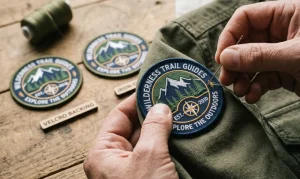
The sew-on patches attach to each other through stitching using threads at the edges of the patches. This is the oldest and most basic method, and this acts as the benchmark for comparing the performance of the other two methods.
Best for: long-term durability and any item that gets washed frequently or worn hard, such as work uniforms, school blazers, and team kit.
Pros:
- The strongest hold of any backing type, often lasting the lifetime of the garment
- Works on virtually any fabric, including materials too heat-sensitive for iron-on
- Gives the cleanest, most professional finish, which matters for uniforms and branded apparel
Cons:
- Requires either a sewing machine or hand stitching, which adds time and sometimes cost
- Once attached, the patch is not designed to be removed and reused elsewhere
- Creates small permanent holes in the fabric where the thread passes through
Good use cases: uniforms, jackets, work clothing, school attire, and the sporting apparel of the team in general, wherever the application requires that the patch remain adhered through many washings over the years. Read our guide on iron-on vs. sew-on for a well-explained comparison.
Hook & Loop (Velcro-Style) Patches
The Velcro hook and loop patches, which are sometimes referred to as Velcro patches, consist of a two-layer fastening mechanism, where the coarse hook layer is sewn at the back of the real patch and the soft loop layer is sewn on the clothing or equipment. When they are pressed against each other, they attach very firmly to each other. Once they are peeled apart, the patch can easily be removed.
Best for: swappable or interchangeable patch setups, where the same item needs to display different logos, ranks, or badges over time.
Pros:
- Removes and reattaches cleanly, hundreds of times over, without damaging the patch or the garment
- Ideal for rotating logos, rank insignia, or name badge systems
- No sewing or ironing required once the loop panel is in place
Cons:
- Slightly higher cost than iron-on or sew-on backing
- Requires a loop panel to be sewn onto the garment first, which is an extra step if the item does not already have one
- The hook side can collect lint and pilling over time, gradually reducing grip strength
Good use cases: tactical gear, security and emergency services uniforms, military-style morale patches, and any name badge or rank system that changes regularly.
Comparison Table
| Backing Type | Durability | Cost | Best For | Removable? |
| Iron-On | Low to moderate | $ | Fashion, kids’ wear, one-off events | No, not designed to be |
| Sew-On | High | $$ | Uniforms, workwear, team apparel | No, permanent by design |
| Hook & Loop | High (grip may reduce over time) | $$$ | Tactical gear, rotating badges, security uniforms | Yes, hundreds of times |
How to Decide: 3 Quick Questions
Rather than weighing every pro and con, three questions usually settle it.
How often will the item be washed? Occasional wear points toward iron-on. Regular or commercial washing points firmly toward sew-on.
Do you need to swap or remove the patch later? If the answer is yes, in any capacity, hook and loop is the only one of the three built for that.
What is it going for: fashion, team gear, or tactical or work use? Fashion and promotional items generally suit iron-on. Team and uniform gear suits are sew-on. Tactical, security, and role-based gear suits hook-and-loop.
Can You Mix Backings in One Order?
Yes, this is more common than people think. In some cases, the firm may choose to order a similar logo patch, which would be attached using sew-on backing for coats, iron-on backing for the promotional gifts collection, and hook-and-loop backing for tactical vests.
This kind of customisation not only makes sense but is also quite necessary in order to meet the special demands of different uses. There are no rules according to which all patches in one order should have the same kind of backing. Rather, there is great room for customisation in such orders.
It would be wise to let the supplier know how each patch will be used ahead of time, instead of just going with the least expensive backing. In such a case, it becomes easier for the companies to choose the best type of patch backing according to the environment where the patches will be used.
In other words, patches that are designed for use on outdoor uniforms need to have a stronger patch backing. This is because they will not only be exposed to harsh weather conditions but also constant use.
Furthermore, the patch backers can also use a combination of one or more patch backings to ensure that their products last longer and are able to serve customers in the best way possible.
Many of those customers who wish to have durable patches request a combination of iron-on and sew-on backings. This is because the iron-on patch backing ensures that there is a good bond between the fabric and the patch, while the sew-on patch backing makes it strong.
Furthermore, it is crucial to understand that while choosing a patch backing, emphasis should not be placed on aesthetics alone. Functionality and applicability should also be taken into account.
In some cases, it may be beneficial to choose a hook-and-loop backing simply due to its convenience factor in order to allow for easy attachment and removal of patches, especially when used in uniforms that are worn often and need to be changed.
Thus, all in all, the choice of a patch backing is quite a multifaceted one and depends on a variety of factors, both functional and aesthetic. Thus, discussing these matters with suppliers may prove to be an effective way to make the right decisions.
Frequently Asked Questions
Can iron-on patches be washed?
Iron-on patches suit gentle washing on cotton blends, especially on cool cycles, but fail in commercial laundering. For frequent washing, sew-on backing is recommended for durability.
Is sew-on more expensive than iron-on?
Sew-on patches cost more due to stitching requirements but last longer than iron-ons, which may require more frequent replacements, potentially increasing overall expenses. Some customers prefer a combo of both for extra durability.
What is the minimum order for hook and loop patches?
Minimum order quantities differ by supplier and patch type. Many New Zealand makers offer low or no minimums for hook and loop patches, often combined with larger orders.
Can I switch backing types after ordering?
Switching backing types is easy before production starts but difficult afterward, as it requires remaking the patch. Clarify the choice with the supplier during quoting to avoid issues.
Ordering the Right Backing for Your Patches
It is hard to determine the perfect patch backing. Iron-on is ideal for quick, cheap and wash-resistant applications. Sew-on is for items meant to withstand years of use and frequent washing.
Velcro (hook-and-loop) is for products requiring patches to be removable and reattachable. The decision depends on the actual application and use of the custom patches, rather than selecting the cheaper or expensive ones.
Having issues deciding which backing your design requires among iron-on vs. sew-on vs. hook & loop? Submit your idea to Patch Makers NZ, and our professionals will advise you and provide a free mock-up of your product before the production process starts. Contact us to get a free quote.